Types of Math Problems on the SAT:
1. Grid-Ins:

2. Multiple Choice
Strategies:
- Fill in Values: One of the most helpful things you have during the test are the answer choices themselves. If you have a multiple choice question, especially a formula, you can plug in answer choices to see what works, because you know one of them is the right answer.
- Keep it Simple (The fewer calculations the better / simplify numbers): If you are doing many detailed calculations for a SAT problem, you are probably doing too much work. The questions are designed to be done relatively quickly with little need for a calculator.Keep your answers simple. Simplify numbers where possible. This helps clarify otherwise tricky questions.
- Write, Doodle, and Take Up Space (Keep your pencil moving): When there are diagrams, fill them out with the information from the question. This is especially helpful for geometry questions.Keep your pencil moving if you get stuck on a problem. If you find yourself frozen, setting up the problem or formula can get your brain moving again too.
What You Will Have:
1. A Calculator
2. Reference Info:
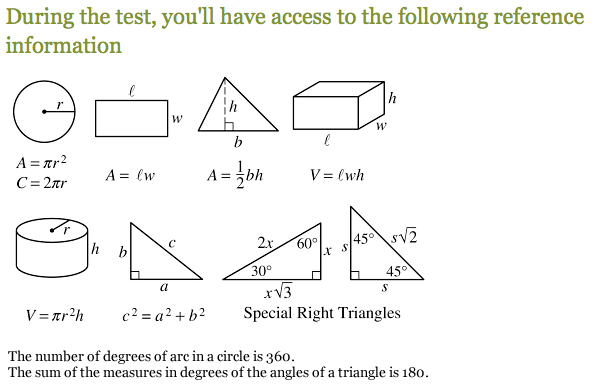
What you will be tested on:
(Top seven most tested concepts from Businessweek and Veritas Prep)
- Properties of Triangles: Spark Notes Triangles
- Ratios and Proportions
- Functions
- Inequalities
- Systems of Equations
- Exponents
- Linear and Quadratic Equations
Math Vocabulary:
The most important thing to have a base in for the SAT is your math vocabulary. You need to know what a question means when it says “integer”, “complementary angle”, or “perpendicular”. Studying math vocab is not like studying SAT vocab. In this case you need to have everything memorized.
Practice Questions from Boot Camp:
1.

2.
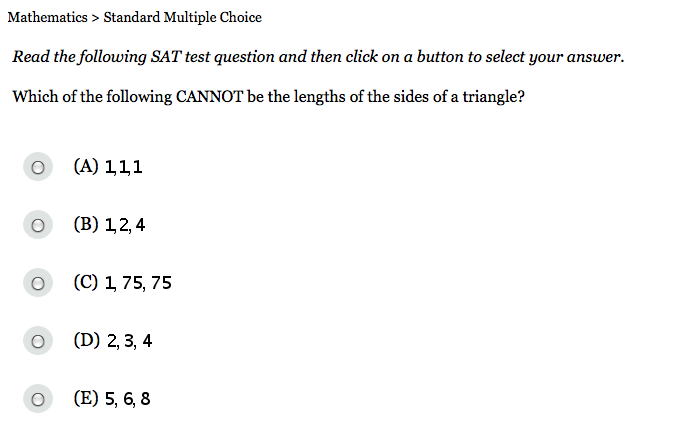
3.
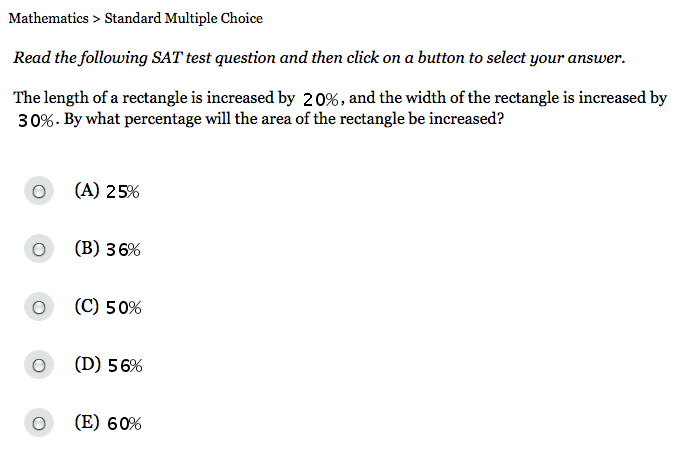
 College Coached